Running a construction business involves much more than managing projects. Between estimates, schedules, invoices, change orders, safety documentation, and team coordination, it’s easy for things to become disorganized. That’s why many contractors turn to construction management software to keep operations running smoothly.
After exploring Contractor Foreman, my biggest impression is that it delivers an impressive amount of functionality at a price point that makes sense for small and mid-sized construction businesses.
Rather than focusing on a single aspect of project management, Contractor Foreman aims to provide an all-in-one solution that helps contractors manage their entire operation from one platform.
What Is Contractor Foreman?
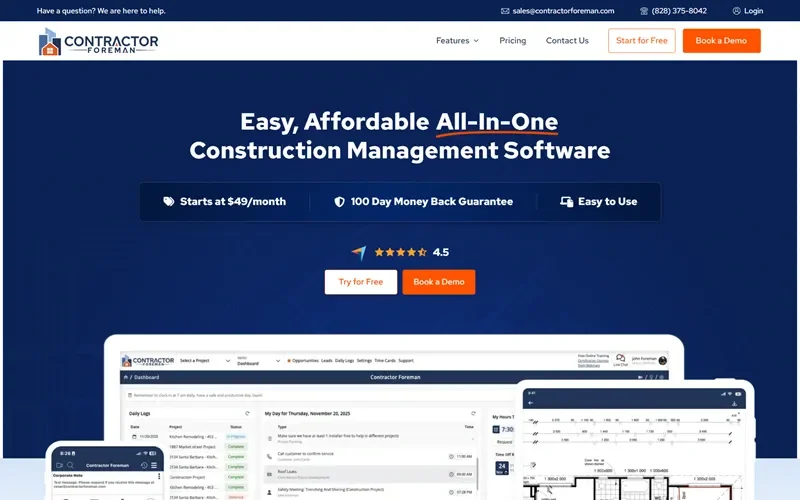
Contractor Foreman is a cloud-based construction management software designed for contractors, builders, remodelers, subcontractors, and construction companies. The platform helps businesses manage projects, schedules, estimates, budgets, documents, safety compliance, and team communication.
Unlike some construction software that primarily targets large enterprises, Contractor Foreman is built with small and growing construction businesses in mind, making advanced project management tools more accessible to a wider audience.
My Experience with Contractor Foreman
One of the first things I noticed about Contractor Foreman is just how much functionality is included.
Many construction software platforms specialize in one area, such as estimating or project management. Contractor Foreman takes a broader approach by bringing multiple business functions together in one system.
At first, the sheer number of tools can seem overwhelming. However, once you spend some time navigating the platform, you begin to appreciate how much administrative work it can centralize.
I particularly liked the idea of having project tracking, scheduling, document management, and financial tools available within a single dashboard. For contractors who are tired of jumping between spreadsheets and multiple software subscriptions, this can be a major advantage.
Why Contractors Choose Contractor Foreman
Construction businesses often adopt Contractor Foreman because it helps bring structure and organization to daily operations.
Some of the most common reasons contractors choose the platform include:
- Managing multiple projects simultaneously
- Tracking schedules and deadlines
- Creating estimates and proposals
- Monitoring project costs and budgets
- Improving communication between office and field teams
- Centralizing construction documentation
- Reducing administrative workload
For growing construction companies, having these capabilities in one place can save both time and money.
What Makes Contractor Foreman Stand Out?
What stands out most about Contractor Foreman is its value proposition.
Construction software can become extremely expensive, especially as businesses grow. Contractor Foreman has built a reputation for offering a wide range of features without the enterprise-level pricing often associated with competing platforms.
The platform also appears to understand the practical realities of construction work. Instead of focusing solely on office management, it includes tools that support field operations, helping teams stay connected regardless of location.
This balance between affordability and functionality is one of the platform’s strongest selling points.
Benefits I’ve Noticed
From my perspective, Contractor Foreman offers several advantages:
Centralized Project Management
Having project information, schedules, documents, and communication tools in one place helps reduce confusion and improve visibility across projects.
Better Organization
Construction projects generate a large amount of paperwork and documentation. Contractor Foreman helps keep everything organized and accessible.
Improved Team Coordination
Whether teams are in the office or on the job site, having shared project information can improve communication and reduce delays.
Scalability
The platform appears capable of supporting businesses as they grow, allowing contractors to add more projects and team members without completely changing systems.
Pros and Cons of Contractor Foreman
Pros
- Comprehensive feature set
- Affordable compared to many competitors
- Designed specifically for contractors
- Supports both office and field operations
- Helps centralize project information
- Useful for small and mid-sized construction companies
- Strong value for the price
Cons
- Large number of features may create a learning curve for new users
- Interface can feel busy at times due to the platform’s broad functionality
- Some users may only need a portion of the available tools
- Setup and customization may require an initial time investment
Who Should Use Contractor Foreman?
Contractor Foreman is particularly well-suited for:
- General contractors
- Remodeling companies
- Residential builders
- Commercial contractors
- Specialty contractors
- Subcontractors
- Growing construction businesses
Companies looking for an affordable all-in-one construction management platform are likely to find significant value in the software.
Final Thoughts
After reviewing Contractor Foreman, my overall impression is very positive.
The platform offers an impressive combination of project management, estimating, scheduling, documentation, and business management tools within a single solution. While there may be a learning curve due to the sheer number of features, the value it provides is difficult to ignore.
For contractors looking to improve organization, streamline operations, and manage projects more effectively, Contractor Foreman delivers a practical and cost-effective solution.
If you’re searching for construction management software that balances affordability with comprehensive functionality, Contractor Foreman deserves a place on your shortlist.