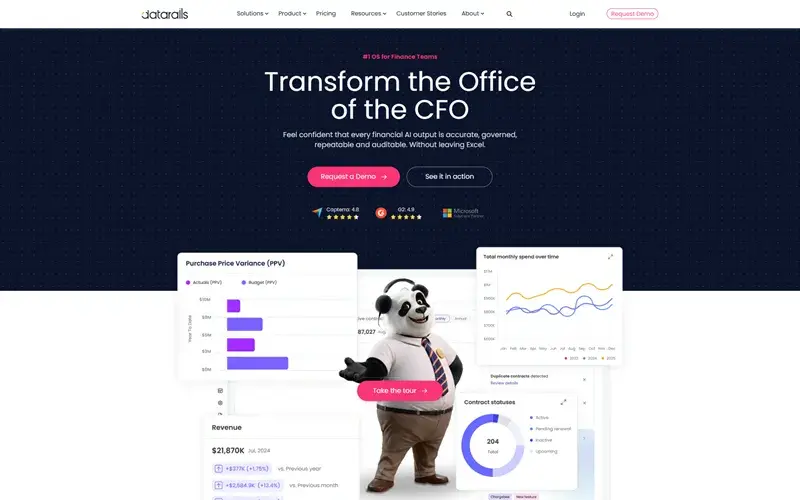
Financial planning can become surprisingly complicated as a company grows. What starts with a simple spreadsheet can eventually turn into multiple files, formulas, budgets, forecasts, and reports that different people need to update and review.
That’s what made me take a closer look at DataRails.
My impression is that DataRails is built for finance teams that want to keep the familiarity of spreadsheets while gaining better control, automation, and visibility over their financial planning processes.
What Is DataRails?
Datarails is a financial planning and analysis (FP&A) platform designed to help finance teams manage budgeting, forecasting, reporting, and financial consolidation.
One of the things that makes it interesting is its approach to spreadsheets. Rather than forcing finance teams to completely abandon Excel-based workflows, Datarails is designed to connect spreadsheet processes with a centralized financial management environment.
For teams that have built years of financial processes around spreadsheets, that can be a major advantage.
My Experience Looking at Datarails
The first thing that stood out to me is the balance between familiarity and automation.
Finance professionals are often comfortable working in spreadsheets, but spreadsheets can become difficult to manage when multiple people are working with different versions of the same file.
Datarails aims to solve some of those problems without forcing teams to completely change the way they work.
I like that approach because adopting new financial software can be a significant project by itself. Being able to preserve familiar workflows while adding more structure makes the transition feel more practical.
Why Finance Teams Choose Datarails
Businesses typically look at Datarails when they want to improve financial planning and reporting.
Common use cases include:
- Budgeting
- Financial forecasting
- Management reporting
- Financial consolidation
- Variance analysis
- Scenario planning
- Automating recurring reporting tasks
For finance teams spending too much time collecting and organizing data manually, automation can make a noticeable difference.
What Makes Datarails Different?
The biggest differentiator is its spreadsheet-friendly approach.
Many FP&A platforms require companies to move away from spreadsheets completely. Datarails takes a different route by helping finance teams connect their existing spreadsheet workflows with a more centralized system.
That can be especially useful for companies where Excel is deeply embedded in financial processes.
I also like the emphasis on reducing repetitive work. Finance teams often spend considerable time gathering data, updating reports, and preparing information for management. Automating some of those processes allows them to spend more time analyzing the numbers.
Benefits I Noticed
Keep Familiar Spreadsheet Workflows
Teams can continue using familiar spreadsheet-based processes while gaining additional financial management capabilities.
Reduce Manual Reporting
Automation can reduce repetitive data collection and reporting tasks.
Better Financial Visibility
Centralizing financial information makes it easier for teams to understand business performance.
Easier Forecasting
Finance teams can organize forecasts and scenarios more efficiently.
Supports Growing Businesses
As financial operations become more complex, having a structured FP&A system can become increasingly valuable.
Pros and Cons
Pros
- Strong spreadsheet integration
- Designed specifically for FP&A
- Helps automate financial reporting
- Useful for budgeting and forecasting
- Reduces repetitive manual processes
- Centralizes financial information
- Familiar approach for Excel-heavy finance teams
Cons
- May be more than smaller businesses need
- Teams may need time to configure their workflows
- The value depends heavily on data quality and setup
- Businesses should evaluate whether its capabilities match their financial complexity
Who Should Use Datarails?
Datarails is particularly suitable for:
- Growing businesses
- Finance departments
- CFO teams
- SaaS companies
- Mid-sized organizations
- Companies heavily dependent on Excel
- Businesses looking to modernize FP&A
If your finance team is spending too much time maintaining spreadsheets and preparing recurring reports, Datarails is worth investigating.
Final Thoughts
After looking at Datarails, I think its biggest strength is that it doesn’t treat spreadsheets as the enemy.
For many finance teams, spreadsheets are still an important part of how they work. The real problem is managing spreadsheets at scale.
Datarails provides a way to bring more automation, organization, and visibility into those existing workflows without completely abandoning the tools finance professionals already know.
If your business has outgrown basic spreadsheets but isn’t ready to completely leave them behind, Datarails offers an interesting middle ground between familiar financial workflows and modern FP&A software.
Check it out — Get DataRails Now