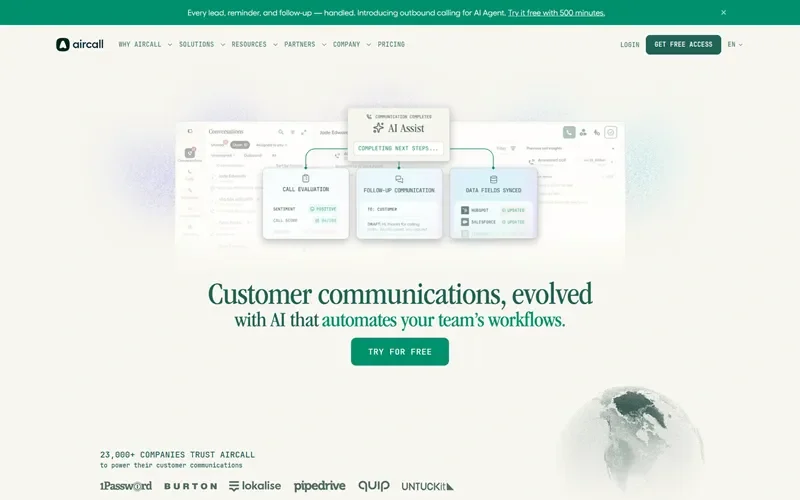
Communication plays a critical role in every business. Whether you’re handling customer support, managing sales calls, or coordinating with clients, having the right phone system can significantly impact productivity and customer satisfaction. Traditional business phone systems often come with complex hardware requirements and limited flexibility, which is why many companies are turning to cloud-based solutions like Aircall.
Aircall is a cloud phone and communication platform designed for modern businesses that want to manage calls from anywhere while keeping their teams connected. Built with remote and hybrid work environments in mind, Aircall provides a flexible solution for companies looking to improve customer interactions and streamline communication workflows.
What Is Aircall?
Aircall is a cloud-based business phone system that enables teams to make, receive, and manage calls through desktop and mobile applications instead of traditional phone hardware. The platform is designed primarily for customer support, sales, and customer-facing teams that rely heavily on phone communication.
Because everything operates in the cloud, businesses can set up phone numbers, manage team members, and monitor call activity from virtually anywhere. This flexibility has made Aircall a popular choice among startups, remote teams, and fast-growing companies.
My Experience with Aircall
One of the first things I noticed about Aircall is how easy it is to get started. Unlike traditional phone systems that often require hardware installations and complicated configurations, Aircall focuses on simplicity.
The setup process feels straightforward, and the interface is modern and intuitive. Team members can quickly start making and receiving calls without spending days learning a new system.
What stood out most to me was how well Aircall fits into existing business workflows. Instead of operating as a standalone phone system, it feels like a communication hub that works alongside other business tools. This makes it easier to keep customer information, call history, and team activities connected.
For teams handling a large volume of calls, having everything organized in one place can make a noticeable difference in daily operations.
Why Businesses Choose Aircall
Businesses often choose Aircall because it helps modernize customer communication without adding complexity.
Some of the key reasons companies adopt Aircall include:
- Supporting remote and hybrid work environments
- Improving customer service operations
- Streamlining sales communication
- Reducing reliance on traditional phone hardware
- Centralizing call management
- Enhancing team collaboration
For growing companies, the ability to scale communication systems without major infrastructure investments can be particularly valuable.
What Makes Aircall Stand Out?
The biggest strength of Aircall is its focus on business communication rather than simply providing a phone line.
The platform is designed to help teams collaborate more effectively by making customer conversations accessible, trackable, and easier to manage. Managers can gain visibility into team performance, while agents can access the information they need to deliver better customer experiences.
Another advantage is flexibility. Since Aircall is cloud-based, teams can work from the office, home, or anywhere else while maintaining a consistent communication experience.
This level of accessibility is especially important in today’s distributed work environment.
Pros and Cons of Aircall
Pros
- Easy setup and implementation
- User-friendly interface
- Cloud-based flexibility
- Suitable for remote and hybrid teams
- Strong integration ecosystem
- Scalable for growing businesses
- Improves visibility into customer communications
Cons
- Can be more expensive than basic VoIP solutions
- Internet connection quality impacts call performance
- Advanced features may require higher-tier plans
- May offer more functionality than very small businesses need
Who Should Use Aircall?
Aircall is a strong fit for:
- Customer support teams
- Sales organizations
- SaaS companies
- Startups
- Remote-first businesses
- Growing customer service operations
- Businesses seeking a modern phone solution
Companies that rely heavily on phone communication are likely to benefit the most from Aircall’s feature set and flexibility.
Final Thoughts
Aircall has established itself as one of the leading cloud phone systems for modern businesses. It combines the reliability of a business phone system with the flexibility and convenience that today’s teams expect.
My overall impression is that Aircall succeeds in making business communication simpler, more collaborative, and easier to manage. Instead of dealing with outdated phone infrastructure, teams can focus on what matters most: building relationships with customers and closing more opportunities.
For businesses looking to upgrade their communication stack, Aircall is a platform worth serious consideration. Its ease of use, scalability, and cloud-first approach make it an attractive option for companies preparing for the future of work.
Check it out — Get AirCall Now